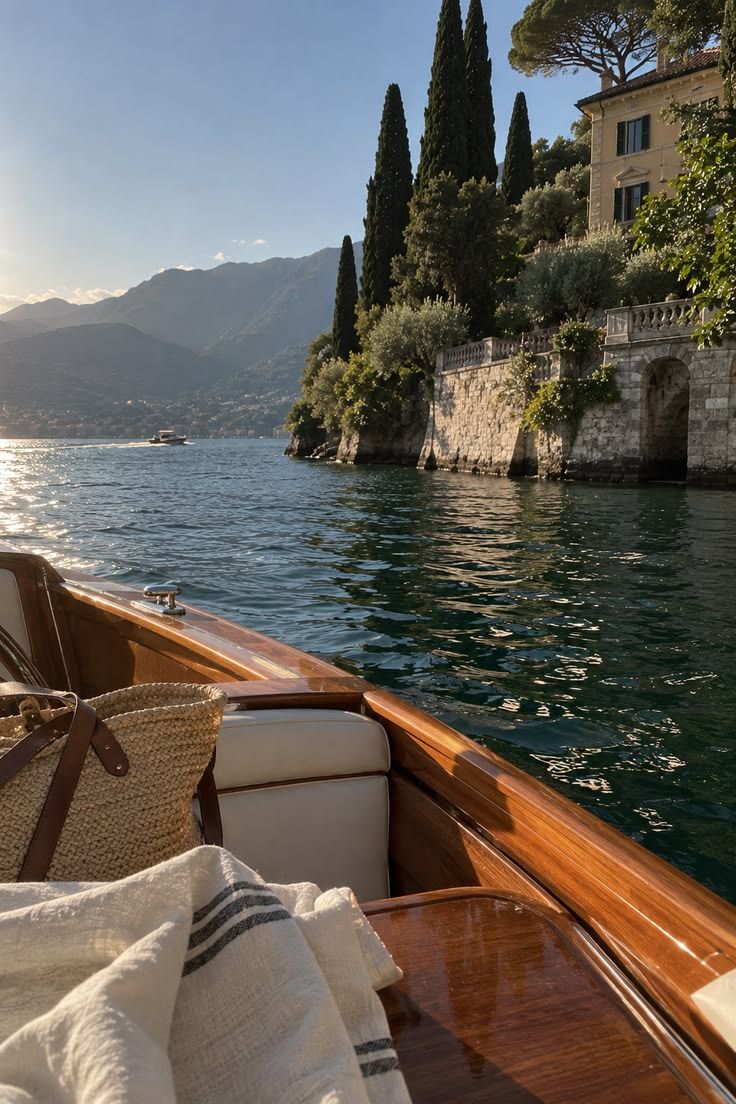
Lake Como is a chain of shores, not a single view. On the public boat, a settlement approaches gradually: first its position against the hills, then a line of buildings, then the landing where passengers leave the lake and enter the town. The geography unfolds at the speed of the crossing.
From the boat, towns appear in relation to one another rather than as names on a list. Their landings make a shoreline legible. The public service lets a traveller watch that relationship develop without rushing straight to the next address or needing a vessel.
Reading the shore
A road can deliver a villa at its gate. From the water, the same building is seen in relation to its bank, garden and neighbouring roofs. The angle changes without asking the passenger to move. A terrace appears, a wall recedes, a path becomes visible. Arrival begins before the boat touches the landing.
The vessel changes that introduction too. The height of a seat, the sound against the hull and the space between fellow passengers all affect what is noticed. A wooden launch and a public ferry offer different experiences, yet both make the crossing a distinct part of the day rather than empty time between places.
The route between towns
Lake Como's public boats make this perspective available without requiring a private vessel. Navigazione Laghi publishes services between Como and Colico and routes linking central-lake towns such as Bellagio, Varenna and Menaggio. Their first purpose is transport. Yet transport changes how a place is understood: the shoreline becomes a sequence of connected settlements rather than a collection of views glimpsed from a road. The boats give visitors a way to experience the lake as a lived geography.
There is practical discipline in travelling this way. A boat follows a timetable; weather and lake conditions can affect service; boarding requires attention to destination. These details do not diminish the crossing. They place it within the ordinary life of the lake, where residents and visitors use an infrastructure that must work as well as look beautiful. The interval between stops belongs to everyone aboard, each person watching for a different reason.
For a traveller from Singapore, an arrival by boat can alter the scale of a trip usually measured in flights and road transfers. A public ferry offers the pleasure of successive stops; a smaller vessel may bring the water nearer. Neither is inherently the more authentic crossing. The question is what each allows the traveller to notice before stepping ashore. Let the journey decide.
What a passing view permits
The official Lake Como tourism guide draws attention to villas and gardens along the water. From a boat, their relationship to the shore can be easier to grasp. A terrace may face the lake; trees can frame a façade or conceal it until the vessel changes angle. The view is less a catalogue of buildings than an account of how architecture, garden and geography meet. The changing perspective gives a place depth that a single photograph cannot hold.
That account has limits. A passing traveller cannot infer who owns a house, when it was built or what happened inside it. The shoreline offers form and setting, not provenance. Looking carefully means resisting the urge to invent a story for every balcony. Sometimes the most useful observation is simply that a place was designed to be approached and understood from the water. Its architecture has a relationship to the route by which people arrive.
Arrival is usually described from the traveller's side. From the shore, however, a boat is also part of the scene: it approaches, pauses and leaves. Buildings made to face water can be understood more fully when seen from that direction.
On the return, the shoreline has acquired a few familiar coordinates. A terrace belongs to a particular bend; a cluster of roofs is no longer anonymous. The same ordinary public route now carries a different, more useful map in the passenger's mind.
Further reading: Lake Como tourism guide to villas and gardens; Navigazione Laghi on Lake Como routes